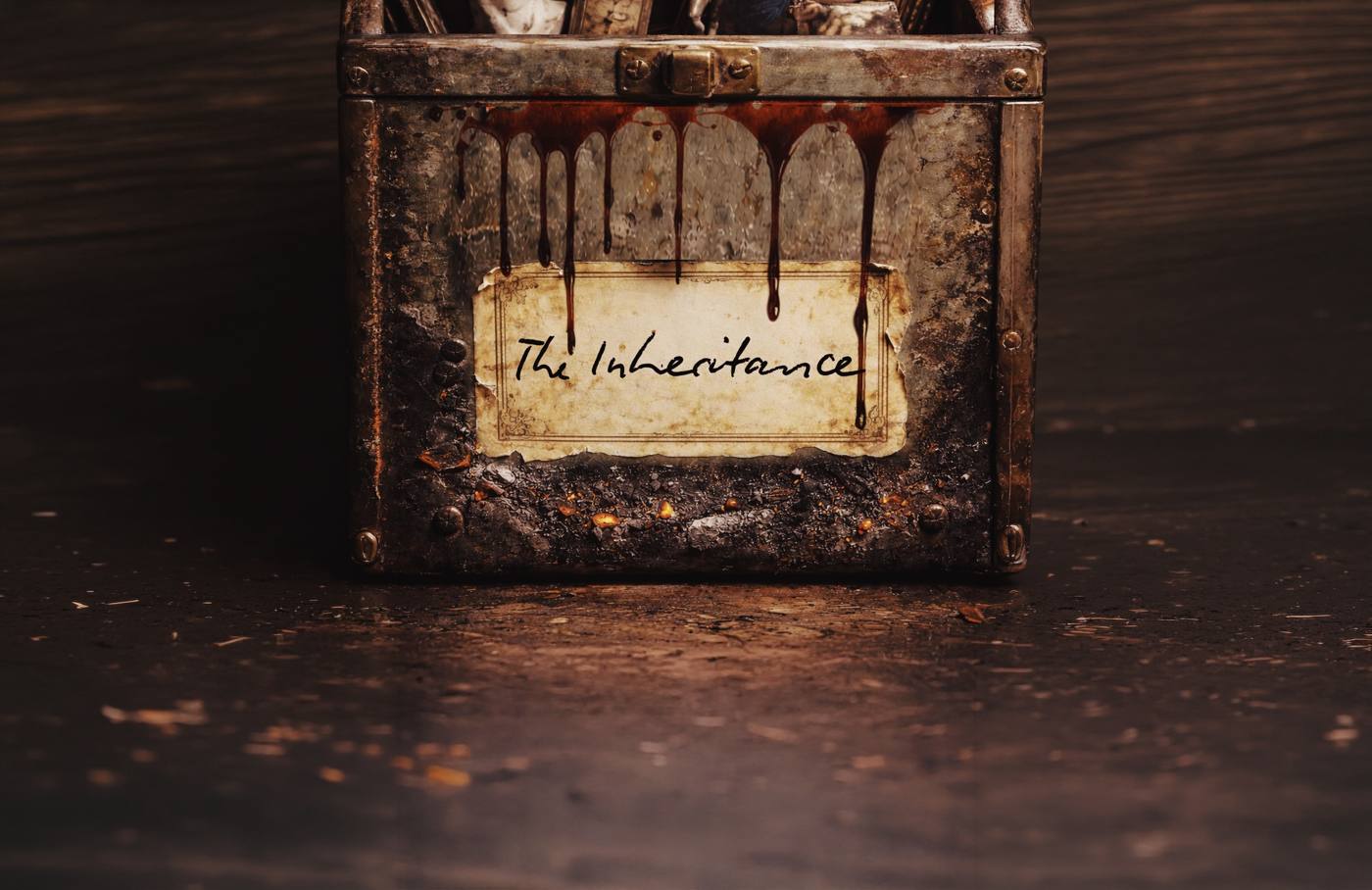
A TREATMENT
The Inheritance
We keep what's ours. What keeps us.
Written by Charlie Shelton
Logline
A guilt-ridden son moves home to care for his ailing parents in a Brooklyn penthouse bought with his grandfather's stolen art, and inherits far more than the money.
A horror film about what we inherit from our parents: the money, the silences, the debts nobody chose, and the cost of paying them back.
The world
A fortune pulled from the rubble
The penthouse
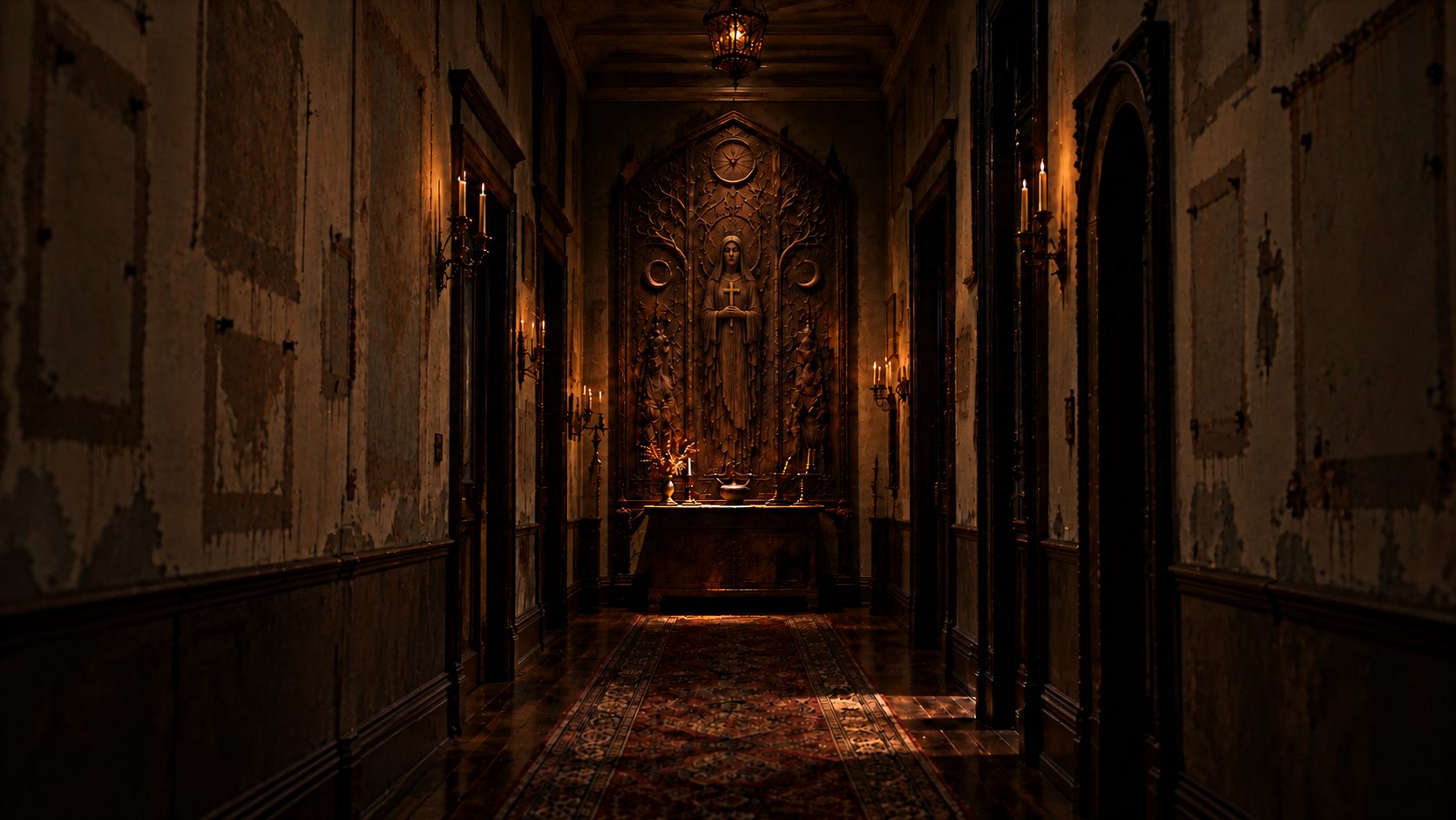
The top floor of a 1928 bank tower on Court Street. A private elevator opens onto a landing shared with one neighbor. Inside, a gallery hall crowded with paintings runs to a terrace facing Manhattan. When Robert Shelton bought the floor in 1951, he rehung every door to swing the other way. No one remembers why.
The money
In the Blitz, Robert dug families out of bombed London houses and kept their valuables. Three generations have lived off the plunder. Each sale leaves a pale rectangle on the wall, and no Shelton asks where a painting came from.
THE CHARACTERS
Those who stayed, and those left behind
Charles, 34
The heir who swore off the family money and lived on it anyway. He came home too late and now won't leave. He runs every day to the minute and explains away whatever doesn't fit.
Mara, 72
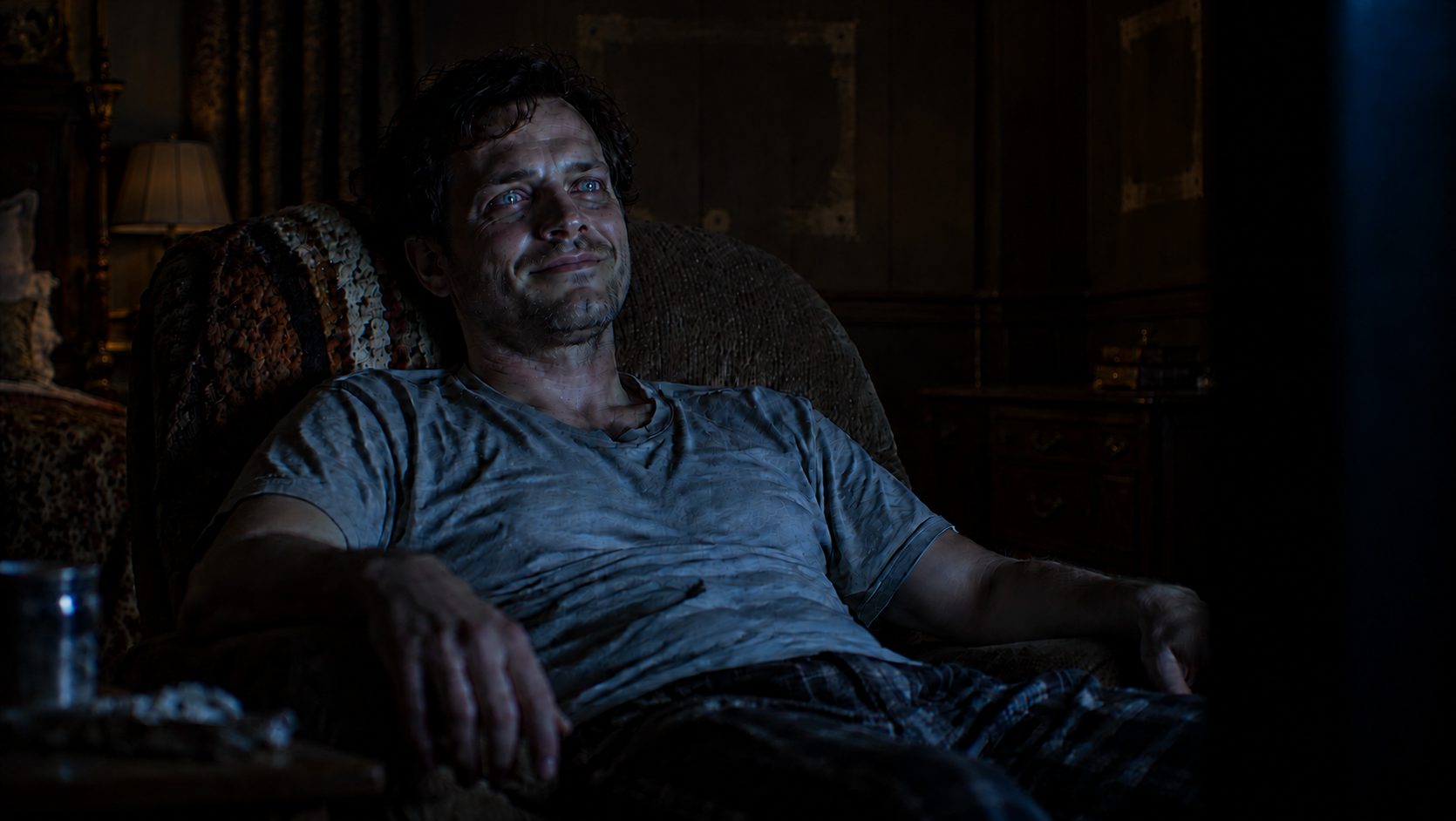
She married into the collection and never asked where it came from. Bedbound and silent since her fall, she watches TV as if keeping time with something only she hears.
Stanley, 78
He sold his father's plunder from a Madison Avenue gallery for forty years. Dementia has taken most of him. He's lucid only at night, alone with Charles.
Robert, 1917–1989
Charles's grandfather, seen only in 1941. A Blitz rescue worker who built the family fortune on what he stole from the rubble, and kept one piece he'd never sell: the altarpiece. His ledger's last line: They want someone to stay. I never could.
The Fletchers
Ellen, her son Thomas and baby Sarah. In 1941 Robert heard them calling from a bombed chapel's crypt in Bethnal Green. He took the altarpiece above them and left them there.
Ms. Kim
The neighbor across the landing since 1979. Three deadbolts to Charles's one. She has heard children singing in his walls for decades.
Renata
The weekly home aide, the only outsider Charles lets in. Her notes record what he won't see.
Mr. Okafor
An Adult Protective Services caseworker. He counts every pill, asks who signs the checks, and is the only one who reads the family's history aloud.
Summary
The story in brief
Three years ago, Mara Shelton fell in her Brooklyn penthouse and lay on the floor for seven hours, calling for help eleven times. Nobody answered. Only late in the film do we learn whose phone she was calling: her son Charles's.
Now Charles has moved home to care for Mara, bedbound and silent, and his father Stanley, lost to dementia. The family is rich from art his grandfather Robert stole during the Blitz. Charles sends the last nurse home, and that night strange things begin.
At first he explains everything away. Every night scare falls between 11:52 and 2:10, the hours of the calls, while an old phone counts up missed calls and a voicemail he can't finish plays a few seconds more each part.
The explanations wear thin. Charles learns that Robert pulled the altarpiece at the end of his hall from a bombed chapel while Ellen Fletcher and her two children were still alive in the crypt below, and left them to die. Ms. Kim, the neighbor, tells him the dead go where somebody stays.
The Fletchers are possessing Mara. Desperate, Charles feeds her an overdose. She dies, but her body keeps moving. When a caseworker finds pills missing, Charles lies to keep his place at her side, and Renata, the aide, covers for him.
Finally he plays the whole voicemail and hears the Fletchers humming with his mother on the floor that night. At 11:52 he kneels between his parents and invites the ghosts into himself. Through Mara's eyes, we watch them pass into her son, and his parents die in peace. Charles returns every stolen painting. On the last morning, three voices answer him from his own mouth. He has become the one who stays, or he is a grieving man talking to himself. The film never says which.
The story
Eleven calls, and what they cost
The night of the calls · Three years earlier
- 11:52 p.m.
One still shot of the dark gallery hall, its walls crowded with paintings. At the far end, a carved altarpiece of a robed woman holding a cross stands in candlelight. Mara follows a wandering Stanley, trips on a rug and falls. She can't get up.
- The phone
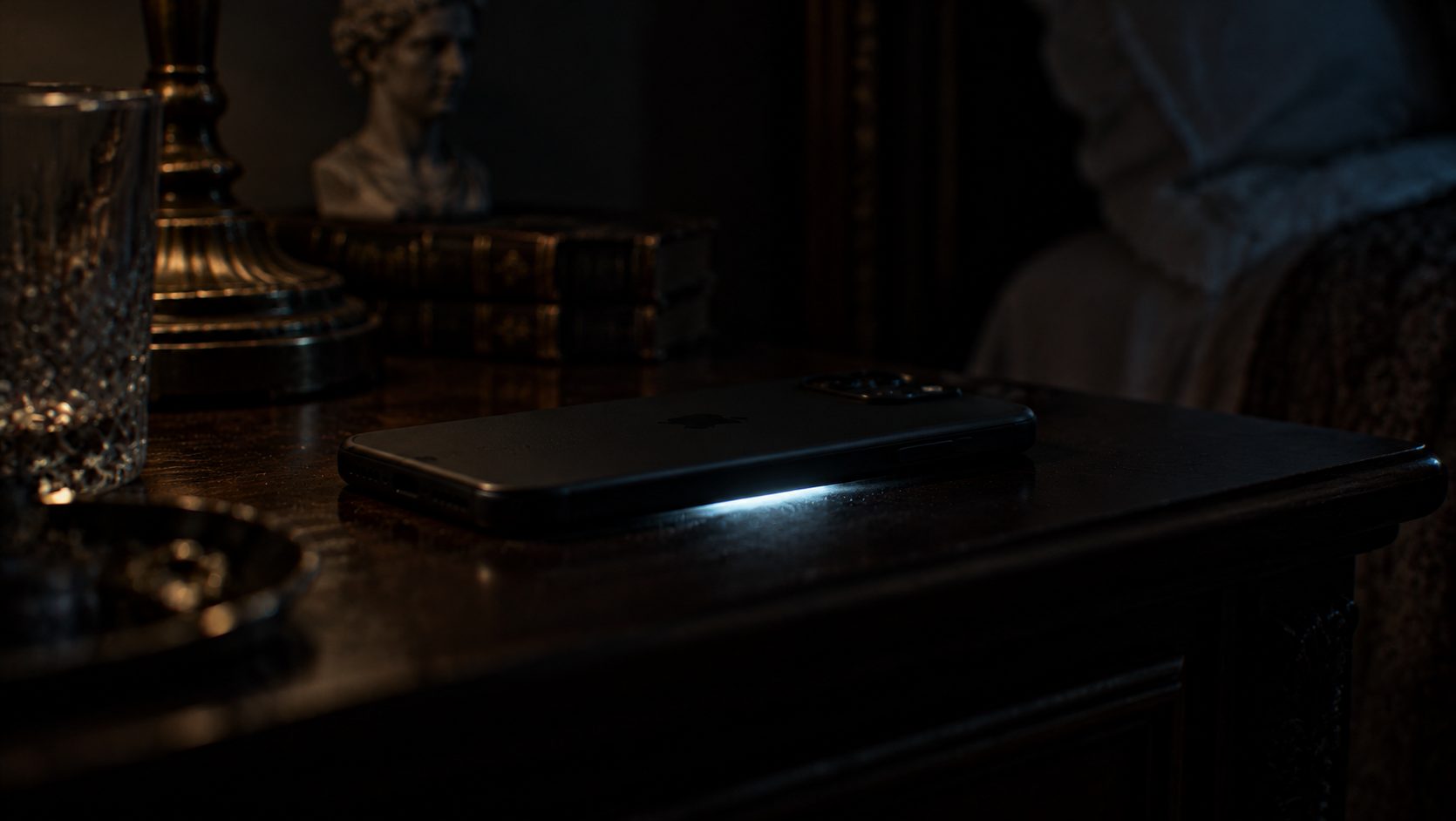
She crawls to her phone and calls. Far away, a phone buzzes face down on a nightstand. A hand turns it over, looks, and turns it back. We never see whose hand. She calls eleven times.
- The hum
Stanley watches TV in the library across the hall and never comes. To stay awake, Mara hums an old tune. Faintly, a second voice hums with her, then a child's.
- 2:10 a.m.
Her last call leaves a voicemail we don't hear. At dawn Ms. Kim hears her through the wall. Seven hours on the floor cost Mara her legs.
The routine
Charles explains everything away.
- The last nurse
Three years later, Charles has moved home. The family can afford round-the-clock nurses. Tonight he sends the last one home for good. She says he can't do this alone. He says he can, and never says why.
- The voicemail
Charles keeps an old phone with a cracked screen in a drawer. He plays the first seconds of a saved voicemail: breathing, a creaking floor. He stops it. We don't know who left it.
- 7:45 a.m.
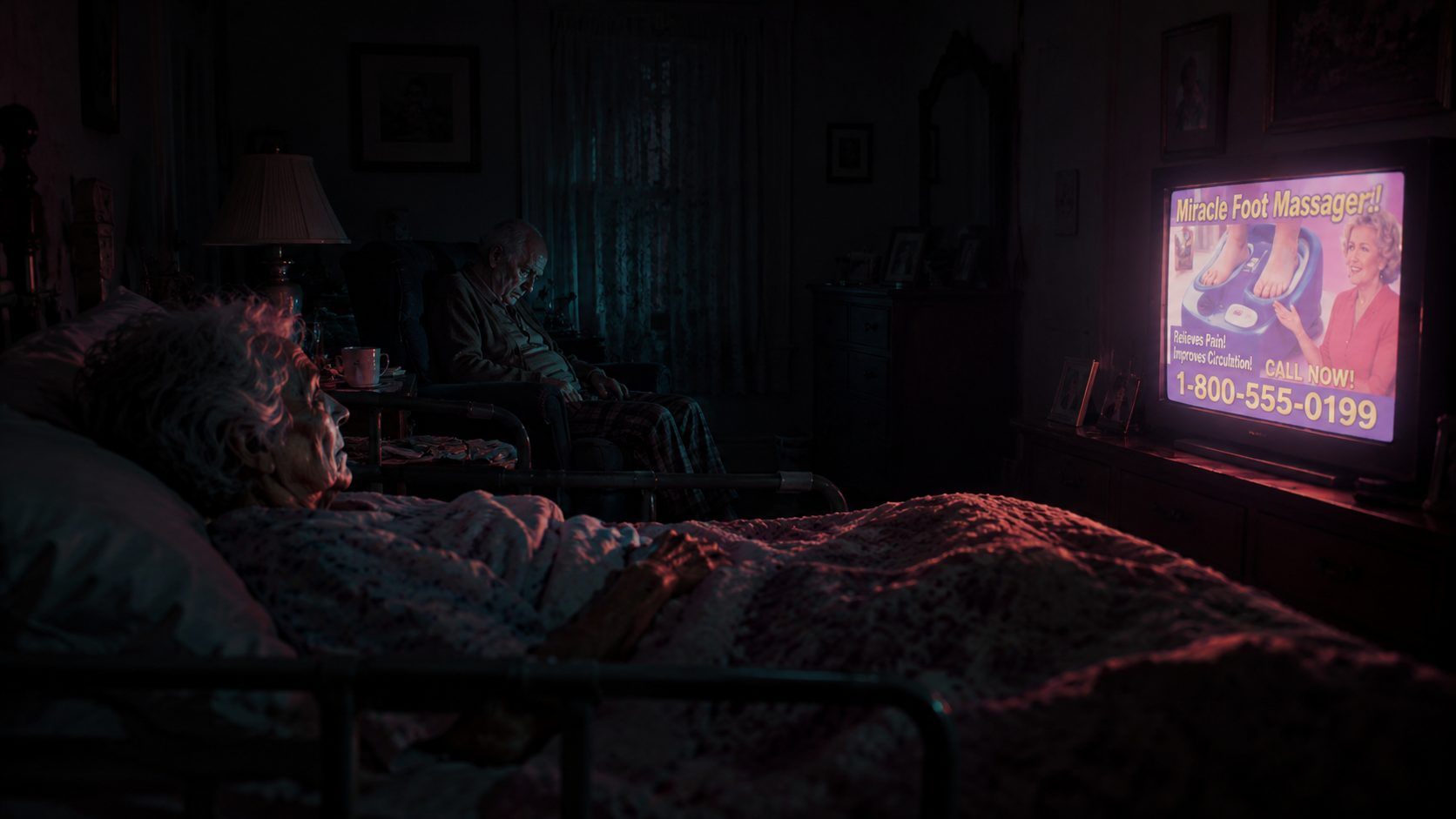
He sleeps on the library sofa. His mother lies in a hospital bed in his old room, her open door facing the altarpiece. A schedule on the fridge runs the day to the minute. At 7:45 he tells Mara the weekday and the temperature, the same two sentences every morning. Her eyes stay on CareTV.
- The log
Charles logs every pill, meal and turn. When something goes wrong, he writes down a reason. The log tracks everything he explains away.
- 8:10 a.m.
Stanley stares at his door's hinges and, clear-headed for a moment, says Robert rehung every door to swing the other way, "to keep something in. Or out." Charles blames the dementia.
- 9:27 a.m.
The CareTV host seems to say Charles's name. Bad signal. He realizes he's late turning Mara, and a pressure sore is forming. From the empty next room, a woman's voice says he's doing his best. He blames the library TV. He logs: 9:31. Late. Tired.
- The sponge bath
As he washes Mara, the vent breathes in time with his hands. When he stops, it stops. Old building, he decides.
- The tune
Charles keeps humming an old tune without noticing. It's the one Mara hummed on the floor.
- Ms. Kim
The neighbor brings soup and asks if he hears children singing in the walls. He blames the pipes. "That isn't pipes." He decides she's lonely. Unopened letters from London pile up in the foyer.
- 11:52 p.m.
At 11:52, the minute Mara fell, the old phone lights up: one missed call, the name hidden by the cracked screen. Charles blames the battery. From now on, every night scare happens between 11:52 and 2:10, the hours of the calls, and each night the phone shows one more.
- October 1941
A cut, without explanation, to the Blitz. A young rescue worker climbs into a bombed chapel with a lamp: Robert Shelton, Charles's grandfather, at twenty-four. Under a minute, no dialogue.
The panel
The explanations get harder.
- The voicemail
More of the voicemail: a woman humming the tune Charles has been humming all week. He stops it.
- Golden hour
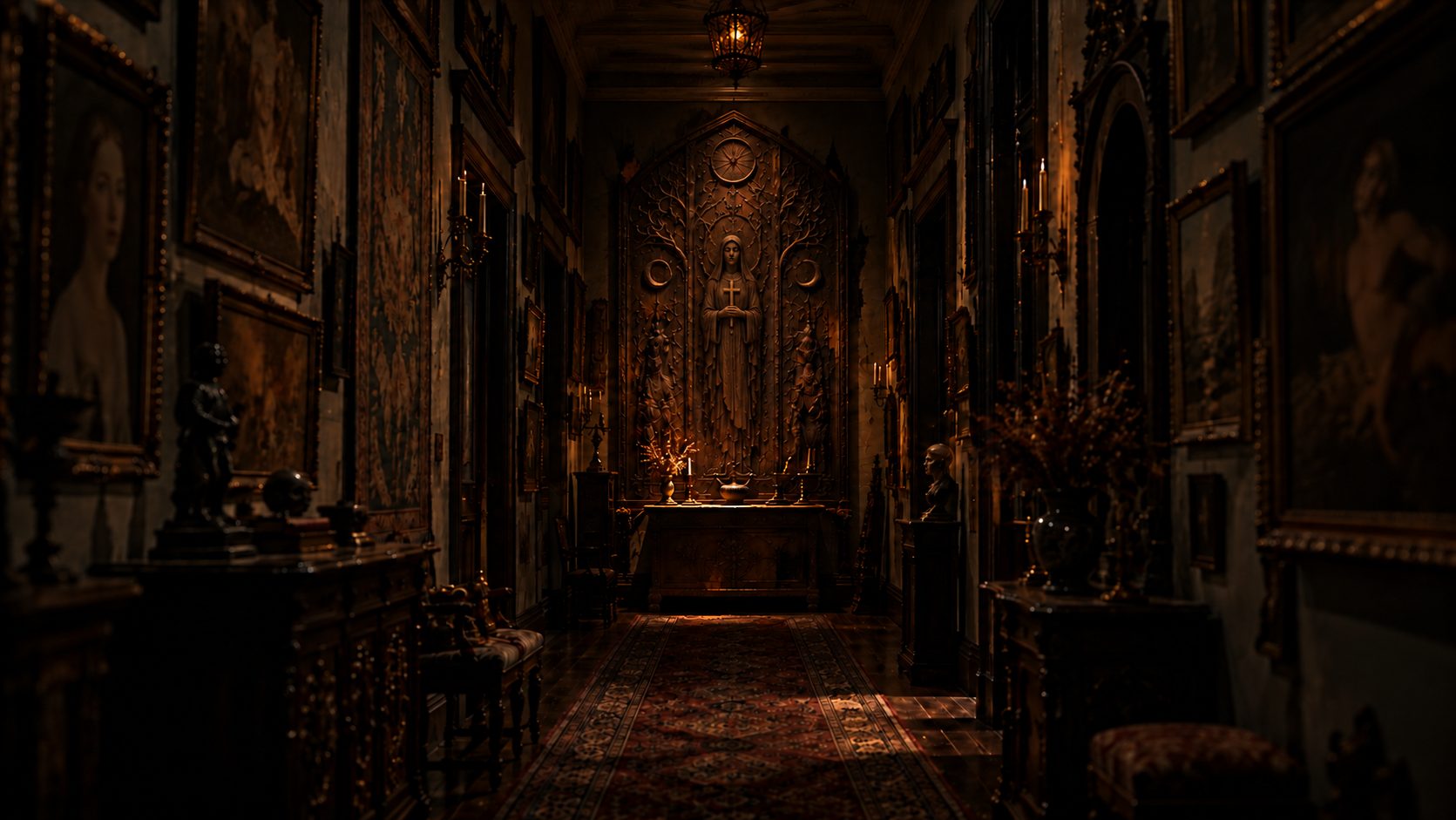
Charles finds himself before the altarpiece with no memory of walking there. He blames exhaustion. The wood feels warm, like skin. Sun, he decides, though that hall gets none.
- The portraits
Every face in the stolen paintings now seems turned toward Mara's door. He takes one down. The wall behind is covered in small, sooty, child-sized handprints. Old soot, he decides, and doesn't check another.
- Dinner
Stanley, clear again: "Daddy took that panel out of Bethnal Green in '41. He took other things too. Everything on these walls." Then he asks what day it is. Charles blames the dementia.
- 12:05 a.m.
In the shower, a child's shadow hums the tune and presses a hand to the curtain. Charles pulls it open: empty. Steam and twenty hours awake, he decides. The phone shows three missed calls.
- 8:00 a.m.
Tuesday's pills are still in the organizer, though his log says he gave them. He gives them anyway and sets a second alarm.
- Lunch
Mara keeps swallowing for a full minute after her applesauce is gone, like a hungry child. The napkin comes away red with brick dust. Charles blames a crack in the ceiling.
- The album
A 1941 photo shows Robert grinning beside the altarpiece in the rubble, a woman, a boy and a baby blurred behind him. Look again, and they're gone. But a clipping in the album is real: Ellen Fletcher, 31, Thomas, 4, and Sarah, 9 months, missing under that chapel. For the first time, Charles can't explain it away.
- The letters
He opens one London letter. Joan Fletcher, Ellen's great-niece, has found Robert's name in a rescue logbook for that night. For the fifth time she asks what he saw. Her family was never found. Charles doesn't answer.
- October 1941
Robert pockets valuables in the ruins. Under the chapel floor, a woman calls for help and a child answers. They're alive in the crypt. Robert listens, then looks up at the altarpiece.
- 1:00 a.m.
Ms. Kim tells Charles she has heard children singing in his walls since 1979. It stopped the night his mother fell, "like they'd found somewhere warm," and started again the night his last nurse left. "They go where somebody stays." He tells himself he doesn't believe her.
- 12:40 a.m.
Footsteps in the hall, though Mara hasn't walked in three years. Wet prints lead to her bed. Her feet are wet, and small muddy footprints cover her sheets. For the first time, Charles leaves the log blank. Six missed calls. The next night her TV goes black and children sing inside it. He unplugs it. A woman's voice speaks from the wall: "We forget, sometimes. How it's meant to go." He can't blame the pipes anymore.
The salvage
He stops explaining and starts counting.
- The voicemail
More of the voicemail: under the humming, a second voice, then a child's. He can't tell if they're on the recording or in the room.
- 8:17 a.m.
Charles turns Mara, washes his hands, and finds her lying as if he never touched her. CareTV's captions: [PLEASE. SHE NEEDS YOU.] He stops writing tired in the log. He writes only what happened.
- Renata
Renata, the weekly aide, goes pale when Charles repeats his father's war story. "He said that?" Leaving, she touches the altarpiece and pulls back. "It's warm." He isn't the only one who feels it.
- The vents
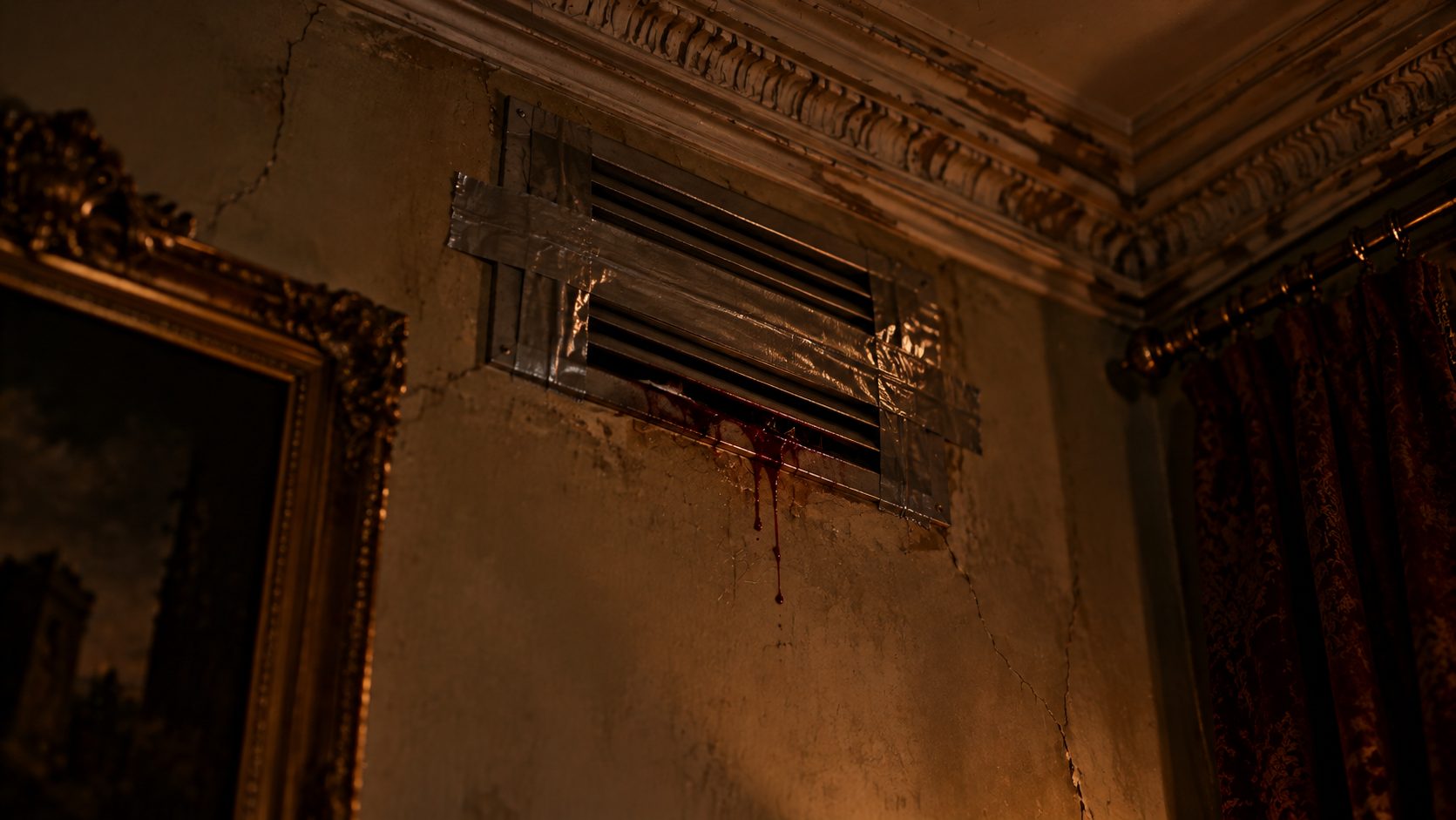
He tapes over every vent. The pipes bang, then go quiet. Behind the tape, two children recite a nursery rhyme and giggle.
- Midnight
He peels back the kitchen vent's tape. A boy's face presses against the grille, reciting Charles's schedule word for word: "Seven forty-five, wake Mom." Charles tapes it shut. The boy recites until 2:10.
- The ledger
In Stanley's closet, a lockbox marked WAR SALVAGE holds Robert's ledger of every theft and sale: Stepney, back bedroom, family not found. Sold 1953. One entry was never sold: Bethnal Green, chapel crypt. Voices. Not for sale. The last page, from the year he died: They want someone to stay. I never could. It matches the clipping. Robert heard the Fletchers alive, took the altarpiece, and left them to die.
- The objects
Also in the box: a carved crow, a straw knot, a piece of etched glass. As Charles lays them out, the TV shows London burning. Mara, unresponsive for months, follows each one with her eyes and blinks three times. Captions: [REMEMBER?]
- 1:15 a.m.
Mara sits up, which she can't do, rocking a blanket like a baby and singing in a London accent that isn't hers. It's Charles's tune. The blanket is cold, wet, heavy and smells of stone. He unwraps it. Empty. She keeps singing.
- 1:40 a.m.
Stanley presses his hands to a bare patch of wall. "I know you're cold. I know you want to come in." Charles feels the wall breathing and punches through it. A dark drop falls from the hole.
- Breakfast
Stanley chews over an empty plate. His mouth is full of brick and mortar, with a child's baby tooth inside. "She was hungry, so I shared." Then he asks for the salt. Charles keeps the tooth: physical proof.
- 2:10 a.m.
The phone shows eleven missed calls. Mara gets out of bed and speaks in three voices: a woman, a boy, a baby. Charles knows them now: Ellen, Thomas and Sarah. "We remembered how." They make her skip down the hall, then crawl, laughing. Softer: "It hurts her. We don't want to hurt her." She collapses. For a moment she is herself, terrified: "Please. Charles. Please." By morning her knees are purple.
- 4:30 a.m.
Desperate, Charles crushes a handful of pills into applesauce and feeds her, believing it will end her suffering. "You'd want this." He falls asleep beside her. Near dawn her breathing stops, and a child starts humming inside her. CareTV: [THANK YOU]. At 7:45 he wakes to find her in her wheelchair by the window. He didn't move her. She has a pulse, but her skin is ice cold and she doesn't blink.
- 2:15 p.m.
Mara grips her bed rail on shaking legs like a toddler, drooling. She falls and laughs like a baby, pulls herself up on his pant leg and babbles, "Ba-ba. Up-up. Da?" She lurches toward him; her hip cracks, and she feels nothing. Then she looks at the altarpiece and wails, "Mama?" A newborn's scream comes out of his seventy-two-year-old mother. He picks her up. She clings hard enough to bruise him for an hour. Sarah is inside her.
- Court Street
Charles drags the altarpiece and Robert's objects to the curb. In the dark elevator back up, the children beg him not to leave them. Upstairs, the altarpiece is back, candles lit. He gives up. "I won't leave."
- October 1941
Robert pries the altarpiece off the crypt wall while another rescuer yells at him to dig. He loads it onto a stretcher meant for the wounded. "We keep what's ours. What keeps us." Below, the woman is still calling.
Outside eyes
Now outsiders explain it away for him.
- The voicemail
More of the voicemail: under the humming, a slurred woman's voice starts to say his name. He stops it.
- 10:10 a.m.
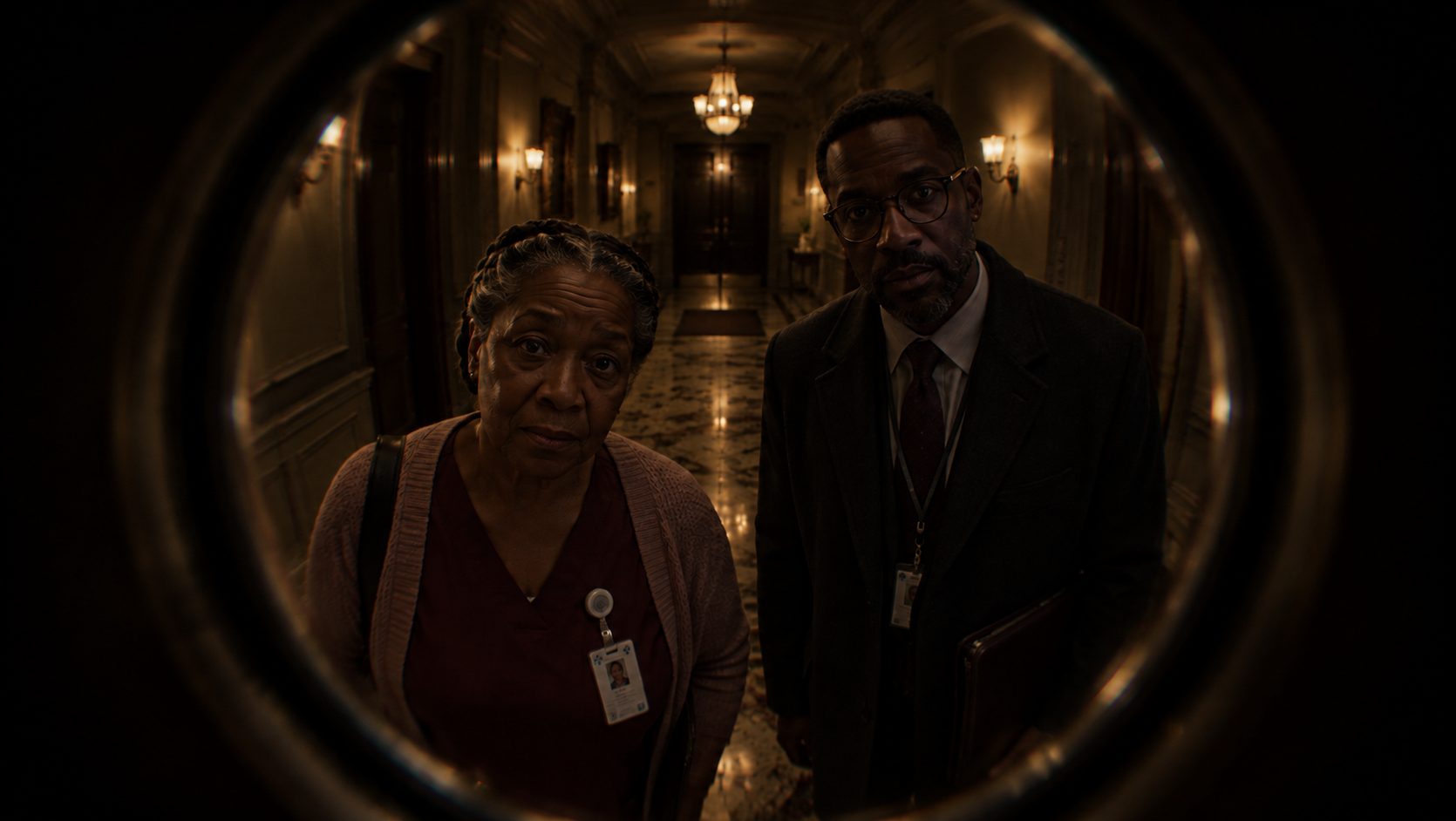
An unscheduled doorbell. Through the peephole: Renata and Mr. Okafor from Adult Protective Services. For the first time we see the apartment through outsiders' eyes, in daylight: a rich family's home with taped vents. Everything could be a caregiver falling apart.
- Renata knows
Renata examines Mara. Blood has pooled in her knees and her hands are ice cold. After twenty years with the dying, Renata knows Mara has been dead at least a day. Yet her heart is beating. Renata looks at Charles, covers Mara, and tells Okafor she's stable.
- The count
Okafor's pill count is short by exactly what Charles crushed. Asked where they went, Charles can confess and lose his place, or lie and stay. He lies: down the sink. Renata backs him. Down the hall, CareTV: [THANK YOU].
- Since April
Charles mentions his father's war stories. Renata says Stanley hasn't spoken a word since April; it's in her notes. Charles realizes the voice he's been hearing at night was never his father's. Something was using Stanley's mouth. But Okafor reads the 1941 clipping aloud. The crime is real.
- The calls
Renata: "You could pay for ten of me. Why are you doing this alone?" Charles confesses the eleven calls. The film cuts back to the prologue's missing shot: the hand that turned the phone over was his. "Somebody is going to be here. Every minute. Me."
- The offer
Okafor offers two weeks of respite care in Riverdale. Charles looks at the altarpiece. "I'll stay." Leaving, Renata touches the altarpiece and says she's seen this once before, in a family that kept someone too long. She doesn't say how it ended. Ms. Kim, through her door: "I've heard them since you were a little boy."
- October 1941
The last 1941 scene, from below. In the dark crypt, Ellen holds Sarah and Thomas. A lamp moves above the stones. She hears a crowbar at the altarpiece and calls for help. Sarah reaches toward the light: "Da?" The footsteps stop, then walk away. Ellen tells her children, "Someone will stay. Someone always stays." Cut to Mara three years ago, alone on the floor, waiting for her son.
- 2:10 a.m.
Charles wakes to a voicemail from his own phone: four minutes of his sleeping breath, then his own whisper, "Please. Mama. Please," and a child's laugh right beside it. The Fletchers are reaching him.
The ending
The last inheritance
The voicemail
Charles plays the whole voicemail for the first time. Mara: "Please. Charles. Please." Then humming that can't be hers, since she's still whispering his name beneath it. Last, a baby says "Da?", the word Sarah called to Robert. The Fletchers found Mara on the floor because she was waiting for someone to stay. Charles knows what he has to do.
The exchange
At 11:52 he kneels between his parents, holds their hands and hums the tune. "You can come to me. Let them go." For the only time, we see through Mara's eyes. Unable to move or speak, she feels the woman, the boy and the baby leave her and pass into her son as cold climbs his arm. Stanley, free, says "Charlie," his only real word in the film. Through Mara's lips, Ellen says, "Thank you." Mara's view goes dark.
Release
Mara dies in peace. Charles closes her eyes at 7:45, the minute he used to wake her. Stanley dies a week later by the window. Renata signs both forms without questions. Charles untapes the vents.
Restitution
Using the ledger, Charles returns every stolen painting. He writes Joan Fletcher the truth. The walls go bare. He keeps only the altarpiece, because the Fletchers live with him now.
7:45
On the last morning, Charles lies in his mother's bed facing the altarpiece and says the weekday and the temperature. Three sleepy voices answer from his own mouth. He is now the one who stays, or a grieving man alone, talking to himself. The film doesn't say.
Black
Over black, four voices hum the tune as a lullaby: a woman, a boy, a baby, and Charles.
What stays open
One rule, two questions
The rule
The Fletchers go to whoever stays. Robert walked away, so they waited in the walls. Mara lay on the floor seven hours, and they found her. When Charles sends the last nurse home, they come for him. In the end, he lets them in.
Love or penance
His sacrifice may be love, the first time a Shelton gives instead of takes. Or self-punishment: a son who failed his mother saving the family his grandfather abandoned.
Victims or hunger
The Fletchers may be what Ms. Kim believes: a mother and children looking for somewhere warm. Or after eighty years they've become something that feeds on the guilt of the family that robbed them.
Recurring motif · CareTV
The wrong channel
Mara's TV never goes off. CareTV sells a family everything except presence, and each ad cuts closer to the night of the calls.

Schedule-Keeper
A pill organizer opens out of order while the voiceover counts the days with total confidence.
Consistency is everything
Devoted Life Alert
A fallen woman calmly repeats that she's fallen. Behind her, someone on the couch never turns around.
Help is already there
Restful Nights
An empty, perfect bed with two dents in the pillows. The sheets slowly exhale.
Rest is earned
Family-Link
A son checks his father's vitals on an app while the father stares at the ceiling.
Distance is impossible
Tone and style
How the film looks and sounds
The frame as liturgy
Still frames, long takes. The routine is shot so patiently that a minute's delay lands like a dropped plate.
Sound before sight
A fridge's hum, knocking pipes, a ticking second hand. We hear the hymn long before we understand it.
One gold hour
Late sun in the gallery hall, amber nightlights, gilt frames in the dark. The wealth is beautiful and lit like a crypt.
The pale rectangles
Every sold painting leaves its ghost on the wall. The walls empty act by act until the house looks like what it is.
The break
In Part Four the camera leaves Charles for the first time. Wide lenses and flat daylight make the haunted home ordinary.
Escalation
Part One's scares can all be blamed on exhaustion and an old building, and Charles blames them. Part Two's take effort. By Part Three, nothing explains them. The audience starts ahead of Charles, catches up as he counts the voices, and ends behind him.
The window
Every night scare falls between 11:52 and 2:10, the hours of the calls, while an old phone counts missed calls from one to eleven. The haunting re-stages the night Charles didn't answer.
The voicemail clock
Each part opens with a few more seconds of one voicemail: breathing, humming, more voices, his name. The full message sends him to his parents' bedside.
Mara's eyes
The film stays with Charles until the exchange, then moves behind his mother's eyes for one scene. We watch the transfer as she does: mute, losing her son to what she carried.
Conclusion
What we inherit, and what it costs
The Inheritance is about what parents hand down that no will can list. Robert left a fortune, a penthouse and a rule: never ask where anything came from. Stanley kept the silence and sold the collection one painting at a time. Charles inherited the money, the guilt, and a phone he once turned face down.
The horror is that inheritance works like possession. No one chooses what they receive. A debt passes from father to son until someone holds all of it, and the dead come to whoever stays. The Fletchers are the bill for eighty years of looking away.
The hope is that an inheritance can be answered. Charles can't undo Robert leaving the rubble, or his own eleven missed calls. He can stay, return what was taken, and carry the cost so his parents can rest. Love or penance, the film won't say. Only that someone has to pay, and it asks each viewer what they still carry for their own family.
We keep what's ours. What keeps us.
The Inheritance
Charlie Shelton